

Server monitoring is an essential part of managing websites, applications, and cloud infrastructure. Servers constantly perform many operations such as handling traffic, running applications, executing background processes, and managing system resources. Because of this continuous activity, administrators need a reliable way to stay informed about important server events. One effective way to manage this is to integrate Telegram with your server monitoring system so that important alerts and updates can be delivered instantly through a messaging platform.
Without a notification system, identifying issues can take longer than expected. System errors, failed deployments, or unusual server behavior may go unnoticed until someone manually checks logs or dashboards. This is why server alert notifications play a critical role in modern server management.
One effective way to receive these alerts is by integrating Telegram with ServerAvatar. Telegram provides a fast and convenient messaging platform that can deliver notifications directly to your device. Once connected, it allows you to receive automated messages whenever specific server events occur.
This guide explains how to integrate Telegram to get server alerts using ServerAvatar, including the setup process, required configurations, and best practices.
What Is ServerAvatar?
ServerAvatar is a server and application hosting and management platform designed to make handling servers easier, cleaner, and more accessible. Instead of working directly with complex server commands, ServerAvatar provides a visual dashboard where you can manage server-related activities more comfortably.
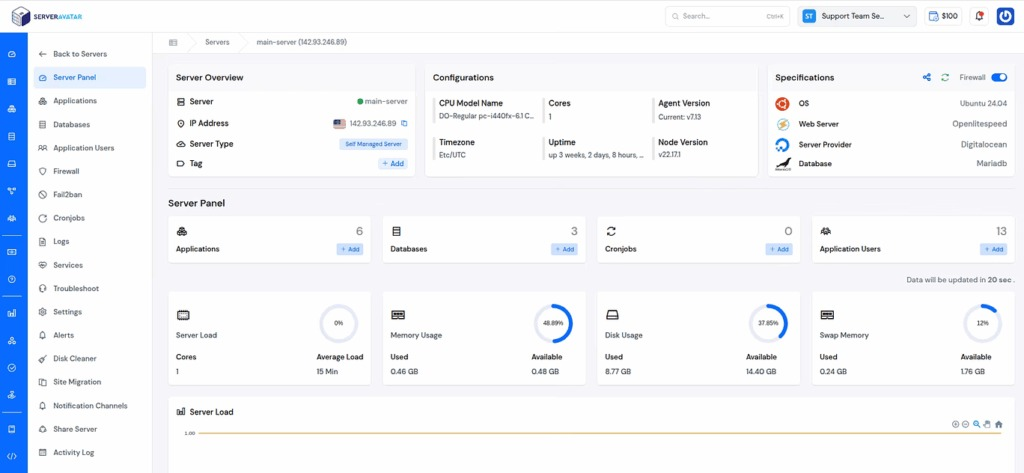
One of the features of ServerAvatar is its notification system. Notifications act as messengers that inform you whenever specific events occur within your server environment. These messages help you stay updated without manually monitoring every detail.
Understanding Server Alert Notifications
Server alert notifications are automated messages generated when specific events occur within a server environment. These alerts help administrators stay informed about system activities, operational changes, and potential issues.
Notifications can be triggered by various conditions, such as:
- Application deployment events
- Backup completion or failure
- Server status updates
- System configuration changes
- Resource usage thresholds
By receiving these notifications automatically, administrators can monitor server activity without manually reviewing logs or dashboards.
Understanding Notification Channels
Think of notification channels as delivery routes. The message is the same, but the delivery method can change. ServerAvatar allows you to configure where notifications should be sent, and Telegram is selected as one such route.
Once it is connected:
- ServerAvatar detects an event
- The notification system prepares a message
- The message is delivered to notification channels
The integration does not change how ServerAvatar detects events. It only changes where the information appears.
Why This Matters
This setup keeps the system flexible. You can add Telegram without affecting other notification methods. Everything works independently but stays organized under one system.
How Notification Channels Work?
ServerAvatar notifications are event-based. This means:
- An event happens
- A notification is triggered
- The message is sent to a selected channel
You get to decide where these notifications go from Slack, Discord, Telegram, and Pushover, as ServerAvatar provides these notification channels. Telegram is one such channel, and it’s particularly popular.
Instead of being reactive, notifications help you stay aware. They quietly work in the background, making sure you’re never completely out of the loop.
What is Telegram?
Telegram is a cloud-based messaging platform designed for fast, secure, and reliable communication. It allows users to send text messages, images, videos, documents, and other files across different devices. Telegram works on smartphones, tablets, desktops, and web browsers, which makes it accessible from almost anywhere.
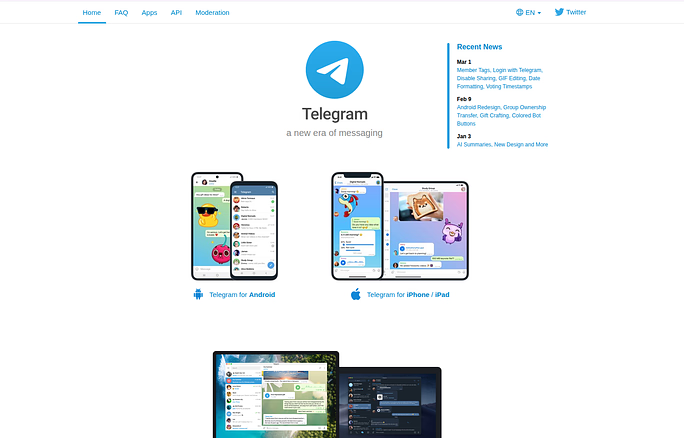
One of the key features of Telegram is its support for automation through bots. Bots are special Telegram accounts that can send messages automatically, respond to commands, and connect with external applications or services. Because of this capability, many tools and platforms use Telegram to deliver automated notifications and alerts.
How Telegram works?
Telegram operates through a simple messaging system that allows users and applications to communicate quickly and efficiently.
- Messages are sent through chats: Communication happens through private chats, groups, or channels where users and bots can exchange messages.
- Cloud-based synchronization: Telegram stores messages in the cloud so conversations can be accessed and synced across multiple devices.
- Instant message delivery: Messages and notifications appear quickly after they are sent, allowing users to receive updates without delay.
- Automated notifications from services: External platforms can connect with Telegram bots to automatically send alerts and system updates to users.
These features make Telegram a convenient platform for receiving automated notifications, including server alerts and system updates.
Why Telegram Works Well for Notifications
Telegram is well-suited for notifications because:
- Messages appear in real time
- Information stays organized
- Alerts are easy to read and track
Once Telegram is integrated, there’s no need to log in to ServerAvatar repeatedly just to check updates.
In simple words, Telegram becomes a shared inbox for your server notifications.
Why Telegram is Useful for Server Alerts
Telegram is a widely used messaging platform that supports automated integrations through bots. This capability makes it suitable for delivering system notifications from monitoring tools and server management platforms.
- Instant message delivery: Telegram delivers notifications quickly, ensuring that messages arrive without delay.
- Cross-platform accessibility: Telegram works on multiple platforms including mobile devices, desktops, and web browsers.
- Bot automation support: Telegram bots allow automated systems to send notifications directly to users.
- Group messaging capability: Notifications can be delivered to individual chats or group conversations.
Because of these features, Telegram provides a reliable channel for receiving server alert notifications.
Telegram Notification Channel Integration with ServerAvatar
ServerAvatar includes a Notification Channels feature that allows users to configure external messaging services for server alerts.
Telegram can be added as one of these notification channels. After the integration is complete, ServerAvatar can automatically send alerts to Telegram whenever predefined events occur.
Examples of events that can trigger alerts include:
- Backup status updates
- Deployment notifications
- System alerts
- Server status changes
The integration allows administrators to receive alerts directly in their Telegram account without accessing the ServerAvatar dashboard.
Requirements Before Setting Up Telegram Alerts
Before integrating Telegram with ServerAvatar, a few prerequisites must be completed.
- Telegram account: An active Telegram account is required to receive notifications.
- ServerAvatar account: Access to the ServerAvatar dashboard is necessary to configure notification channels.
- Telegram bot: A Telegram bot must be created to send automated messages from ServerAvatar.
Once these requirements are prepared, the integration process can begin.
Step-by-Step Guide to Telegram with ServerAvatar
ServerAvatar lets you add Telegram as a notification channel directly from the dashboard. This process does not require changing any server settings or accessing sensitive configurations. You’re simply defining where ServerAvatar should send alerts.
Creating a Telegram Bot for Notifications
Telegram bots act as automated messengers that deliver alerts from external systems. Bots are created through a built-in Telegram service called BotFather. Let’s now create a Telegram bot:
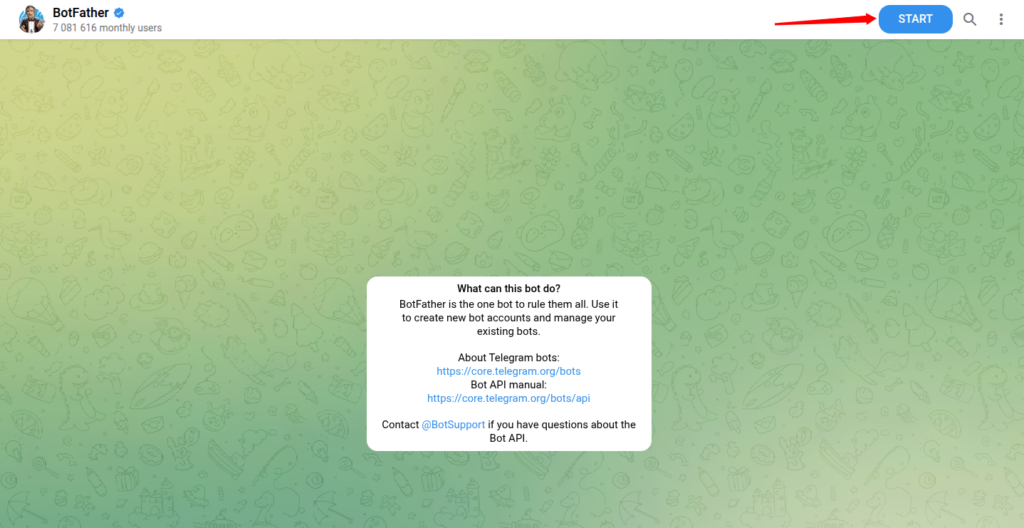
- Open your Telegram, navigate to the search bar, and search for BotFather.
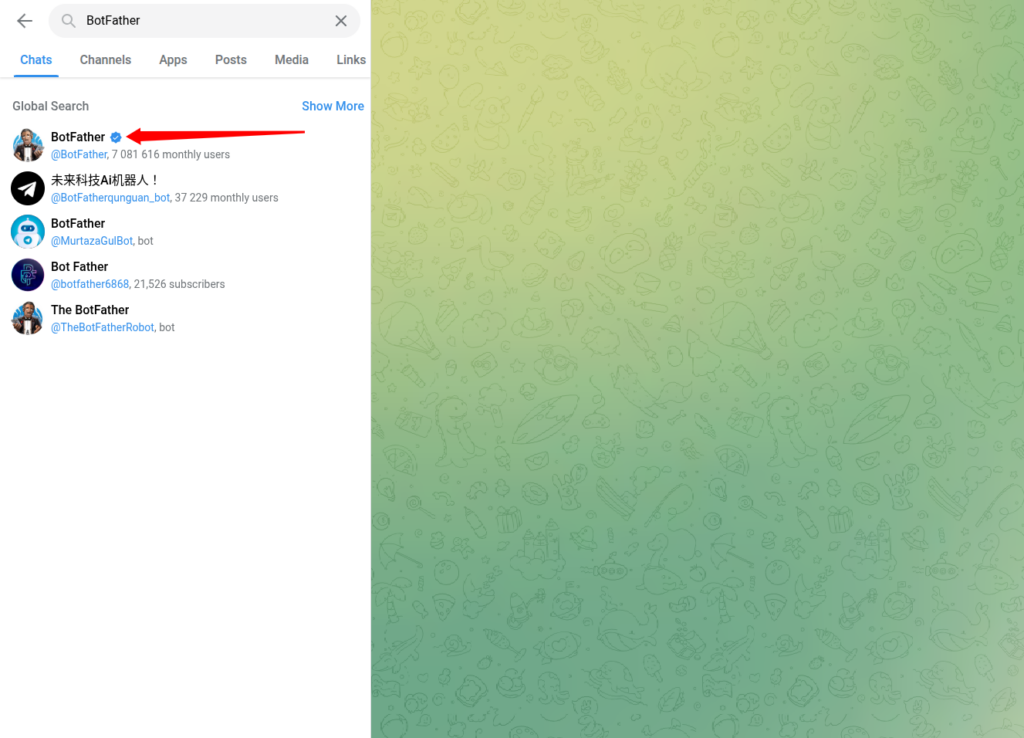
- Open the BotFather chat and click on the Start button from the top right corner.
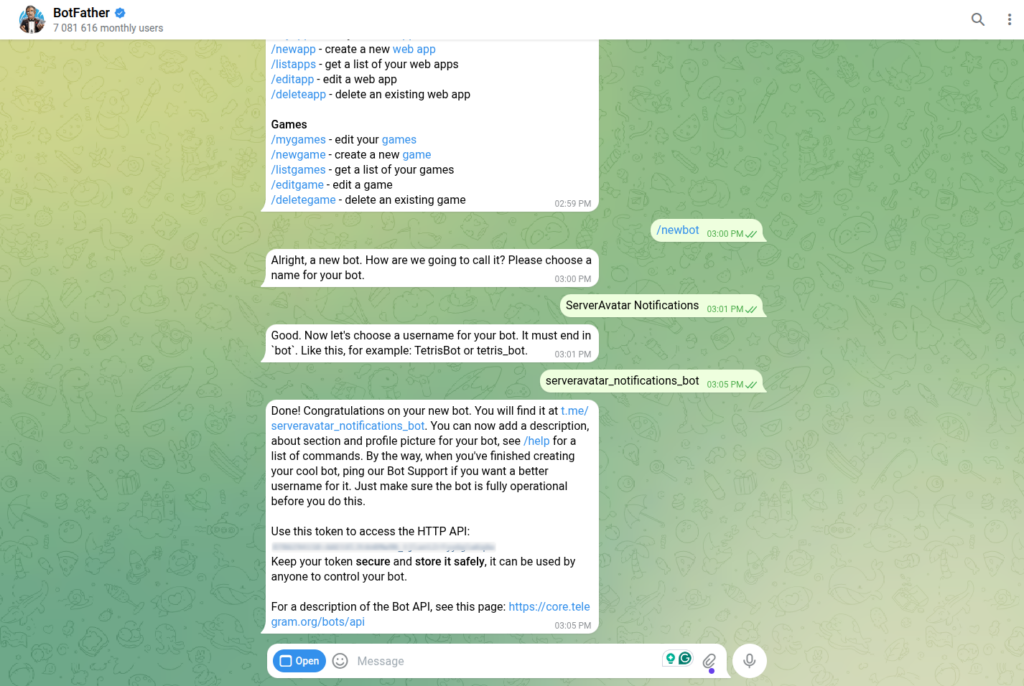
- Let’s now create a new bot by sending the following command:
/newbot- Provide a descriptive name for your bot.
- Now, set a bot username, and make sure the username must ends with bot.
- Example format:
server_alerts_bot- After completing these steps, BotFather will generate a bot token.
Obtaining Telegram Bot Token
- The bot token is a unique authentication key used to connect Telegram bots with external applications.
- After creating the bot, BotFather provides a token similar to the following structure:
123456789:ABCDEF123456example- This token allows ServerAvatar to send messages through the Telegram bot.
Important: The bot token should always be kept private and stored securely.
Get Telegram Group ID
- To complete the Telegram integration with ServerAvatar, you need the Telegram Group ID (Chat ID). This is the unique identifier of the group where the bot will send notifications.
1. Add the Bot to a Telegram Group
First, you need to add the created bot to a Telegram group.
- Open your Telegram group.
- Click on Add Members.
- Search for your bot using its username and add it to the group.
If you do not already have a group, follow these steps:
- Create a new Telegram group.
- Add at least one member, as Telegram requires a minimum of two members to create a group.
- Once the group is created, add your Telegram bot to the group.
2. Retrieve the Group ID
- To get the Group ID, you need to use the bot token generated earlier.
- Open the following URL in your browser:
https://api.telegram.org/bot<YOUR_BOT_TOKEN>/getUpdates- Replace <YOUR_BOT_TOKEN> with your actual bot token.
- Example:
https://api.telegram.org/bot8786294158:AAEtXlJt4nRMw9N_tjlaniZrFyy6glwKqAw/getUpdates3. Check the API Response
- After opening the URL, you will receive a JSON response similar to the following:
{
 "ok": true,
 "result": [
  {
   "update_id": 123456789,
   "message": {
    "chat": {
     "id": -5171172256,
     "title": "ServerAvatar Notification Group",
     "type": "group"
    }
   }
  }
 ]
}- The important part is:
"id": -5171172256- This negative number is your Telegram Group ID.
- Copy the Group ID as we have to add it in the ServerAvatar when we integrating telegram.
Connecting Telegram with ServerAvatar
Once the Telegram bot is created and the token is available, the next step is linking the bot with ServerAvatar.
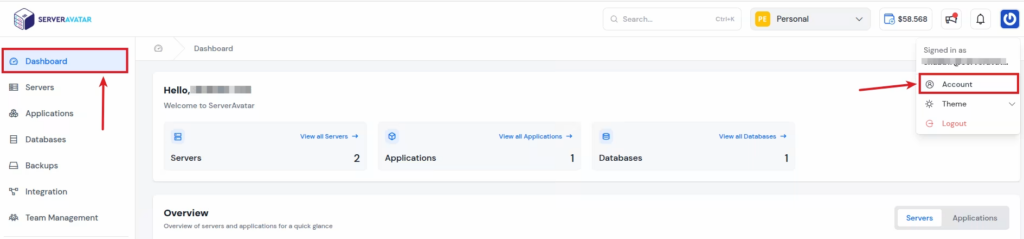
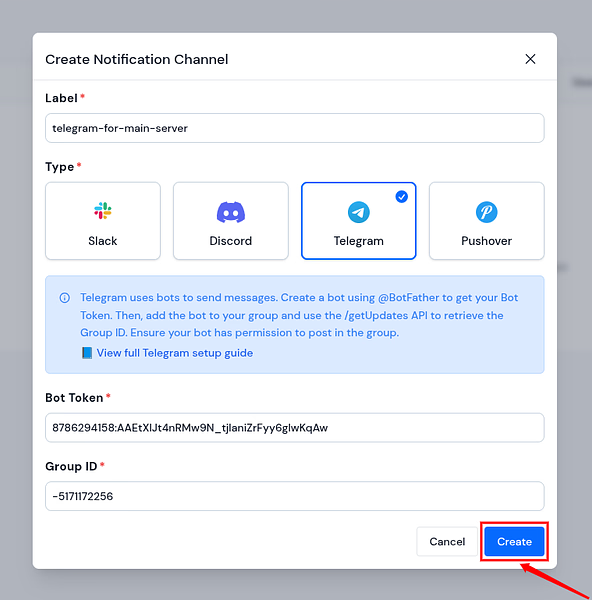
All notification channels are managed from the Account Settings section in the ServerAvatar dashboard. This is where you can configure different communication methods, including Telegram.
- Let’s first log in to the ServerAvatar account and navigate to the Account Section from the top right corner.
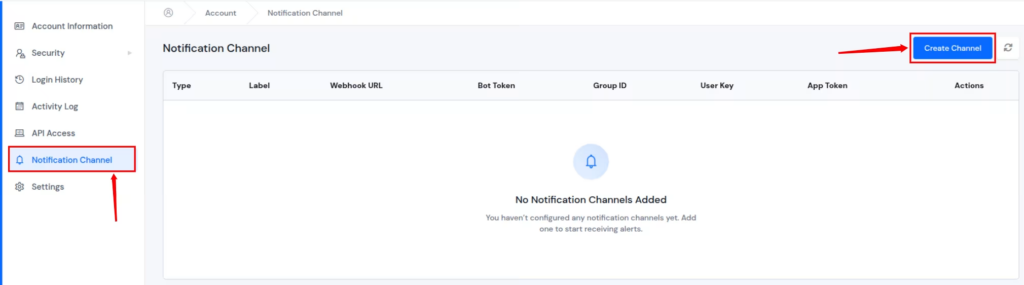
- Select Telegram as the notification channel, and enter the Label for your Telegram notification channel.
- Enter the bot token generated by BotFather in the Bot Token section.
- Enter the Group ID generated previously.
- After entering the details, click on the Create button.
- After adding the Telegram notification channel, you can view the integrated notification channel displayed.

It’s important to understand that adding Telegram as a notification channel from the Account Settings only enables notifications at the account level.
This means you will receive general account-related alerts, but server-specific activities will not be sent to Telegram automatically.
How Account-Level Notifications Appear in Telegram
Once Telegram is added as a notification channel at the account level, ServerAvatar starts sending account-related alerts directly to your Telegram.
Each alert is displayed as a clear, readable Telegram message, making it easy to understand what action occurred and when it happened.
Examples of account-level notifications
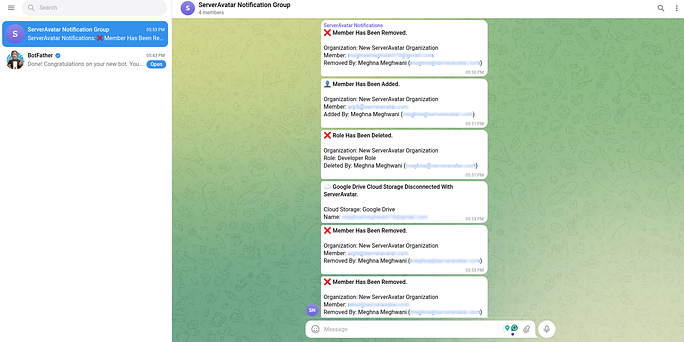
To receive alerts related to the server and particular applications in the server, the notification channel must be attached to the server.
This step is commonly missed during setup, but without attaching the notification channel at the server level, Telegram will not receive server activity alerts.
How to get Server-Level Notifications in Telegram
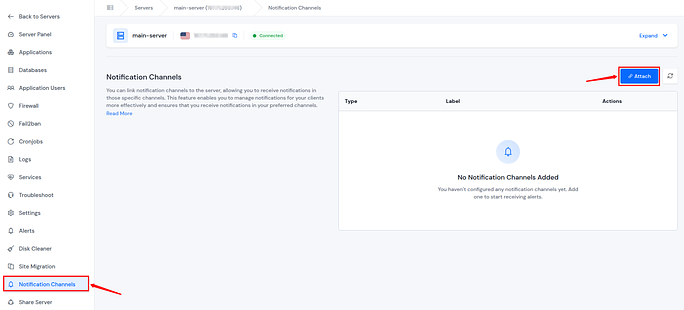
Now, let’s attach the notification channel to the server to get all the server-level notifications.
- Navigate to the server panel by clicking on the server dashboard icon.

- Go to the Notification Channels from the left sidebar and click on the Attach button.
- Select your created Notification Channel from the dropdown and click on the Attach button.
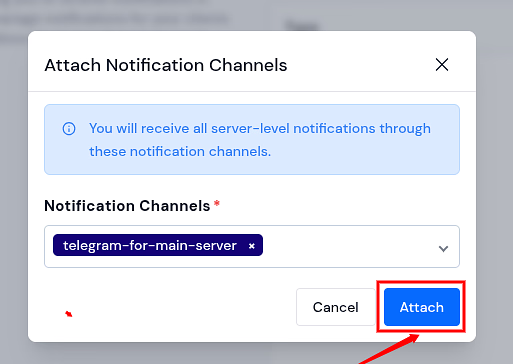
- You can see your notification channel listed, once your notification channel is connected to your server.

By integrating Telegram with ServerAvatar and attaching the notification channel to your server, you get instant updates about server activities directly in your Telegram.
This helps you keep track of your server easily without logging into ServerAvatar all the time.
Examples of server-level notifications
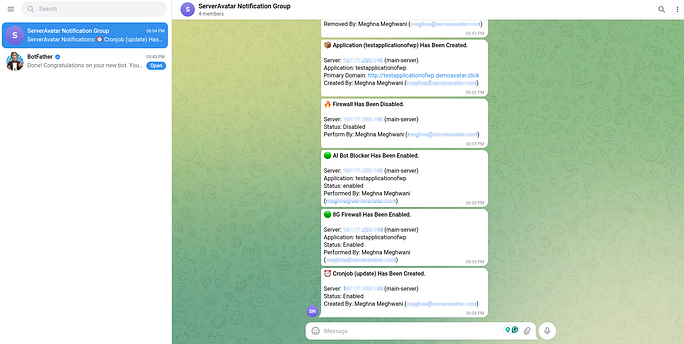
Types of Alerts Sent to Telegram via ServerAvatar
Once Telegram is integrated with ServerAvatar and the notification channel is properly attached, the system can send a wide range of alerts directly to your Telegram.
Account-Level Alerts
Account-level alerts are triggered by activities related to your ServerAvatar account, integrations, and organization settings. These notifications are sent as soon as the Telegram is added at the account level.
User-Level Alerts
These alerts help you stay informed about important security and account-related actions:
- Whitelist IP added
- Two-factor authentication (2FA) enabled or disabled
- Wallet credit added
Integration-Level Alerts
These notifications inform you when third-party services are connected or removed from your account:
- Cloud provider connected or removed
- Git provider connected or removed
- Storage provider connected or removed
Organization-Level Alerts
These alerts keep track of team and role management activities:
- Organization member added or removed
- Role created, updated, or deleted
Server-Level Alerts
Server-level alerts become active once the Telegram notification channel is attached to a specific server. These notifications cover server operations, services, applications, and security-related events.
Server Alerts
These alerts focus on core server activities and system-level changes:
- Server created, deleted, or restarted
- Server IP changed
- Server shared
- Server metrics updates
- Disk usage checked
- Memory usage checked
- Server load checked
- Disk cleaned
- Swap updated
Cronjob Alerts
- Cronjob created, updated, or deleted
- Cronjob enabled or disabled
PHP & Configuration Alerts
- PHP extension installed or removed
- PHP-FPM configuration updated
Security Alerts
- Database root password updated
- Redis settings updated
- Fail2Ban enabled, disabled, or updated
Service Alerts
- Service started, stopped, restarted, or reloaded
- Service monitoring enabled, disabled, or updated
Firewall Alerts
- Firewall enabled or disabled
- Firewall rule created or deleted

Troubleshooting Telegram Integration Issues
If Telegram alerts do not appear after configuration, the following checks can help identify the issue.
Common problems
- Incorrect bot token: Ensure the token entered in ServerAvatar matches the one generated by BotFather.
- Invalid group ID: Verify that the group ID corresponds to the correct Telegram conversation.
- Bot not activated: Make sure the bot chat has been started within Telegram.
Benefits of Telegram-Based Server Alerts
Using Telegram for server alerts offers several advantages for system administrators and development teams.
Key benefits
- Automated notification delivery: Alerts are generated automatically based on server events.
- Accessible messaging platform: Telegram provides easy access to notifications across multiple devices.
- Centralized alert monitoring: All messages are stored within a single chat interface.
- Quick integration process: Telegram bots allow straightforward integration with monitoring systems.
These benefits make Telegram a practical notification channel for server management.
Common Use Cases of Telegram Alerts
This integration is useful for many types of users who want to stay updated without constant logins. It quietly works in the background while you focus on your actual work.
Common use cases:
- Startup founders: Keep an eye on production servers without technical overhead.
- DevOps teams: Track server health and system events in real time.
- Agencies: Manage and monitor multiple client servers from one place.
- Freelancers: Stay informed without being logged in all day.
It’s like having an assistant watching your servers.
How This Integration Improves Productivity
Telegram notifications help you work smarter, not harder. By reducing tool switching, you stay focused on what actually matters.
Productivity benefits:
- Faster notifications: Respond quickly before issues escalate.
- Less downtime: Early alerts help prevent bigger problems.
- Better team collaboration: Everyone sees the same updates instantly.
- Peace of mind: You know your servers are being watched.
It’s a small setup with a big impact.
Conclusion
Integrating Telegram with ServerAvatar provides a simple and efficient way to stay informed about important server activities without constantly monitoring the dashboard. By configuring Telegram as a notification channel, administrators can receive automated alerts for account events, server operations, security changes, and system updates directly within their Telegram chat. The setup process involves creating a Telegram bot, obtaining the bot token and group ID, and connecting the notification channel through the ServerAvatar dashboard. Once configured correctly and attached to the desired server, Telegram becomes a convenient communication channel for tracking system events and maintaining better visibility over server operations.
FAQs
1. What is the purpose of integrating Telegram with ServerAvatar?
Integrating Telegram with ServerAvatar allows users to receive automated notifications about account activities, server events, and system updates directly in their Telegram chat.
2. Do I need to create a Telegram bot to receive server alerts?
A Telegram bot is required because it acts as the messenger that delivers automated notifications from ServerAvatar to your Telegram chat or group.
3. Why am I not receiving server alerts after adding Telegram as a notification channel?
Server alerts will only appear after the notification channel is attached to a specific server. Adding Telegram at the account level only enables account-related notifications.
4. Can Telegram alerts be sent to a group instead of a personal chat?
Telegram alerts can be sent to a group by adding the bot to the group and using the group’s chat ID when configuring the notification channel.
5. What types of alerts can ServerAvatar send to Telegram?
ServerAvatar can send various alerts including account activity notifications, server status updates, deployment events, security changes, cronjob updates, and system service alerts.