

If you’re building a website or application, one big question often comes up: PostgreSQL vs MySQL, which one should you choose? It’s like choosing from two reliable options. Both will get you where you need to go, but the experience, flexibility, and features can vary quite a bit depending on your requirements.
Databases are the backbone of modern applications. Whether you’re running a blog, an eCommerce store, or a complex SaaS platform, your choice of database can impact performance, scalability, and even future growth.
In this guide, we’ll break everything down in simple terms so you can confidently decide which database fits your project best.
What is PostgreSQL?
PostgreSQL is an advanced, open-source database system known for its power, flexibility, and standards compliance.
Think of PostgreSQL as a multi-tool. It’s designed to handle complex queries, large datasets, and custom operations with ease. Developers love it because it supports advanced features like JSON, full-text search, and custom functions. In simple terms, PostgreSQL is built for complex and data-heavy applications.
Core Features
- Supports advanced data types like JSON, arrays, and custom objects
- Fully ACID-compliant for reliable transactions
- Powerful indexing methods for faster query performance
- Supports complex queries and joins efficiently
- Built-in full-text search capabilities
- Highly extensible with custom functions and extensions
- Strong support for concurrency (multiple users at once)
- Open-source with regular updates and improvements
Benefits
- Excellent for handling complex and large datasets
- High data accuracy and consistency
- Flexible and customizable for different use cases
- Strong security features like row-level access control
- Ideal for analytics and data-heavy applications
- Active community support and continuous development
Limitations
- Slightly more complex to learn for beginners
- Setup and configuration can take more time
- May consume more system resources
- Not always the fastest for simple, read-heavy queries
Best For: PostgreSQL is best for applications that require complex queries, high data integrity, and scalability.
Why Need PostgreSQL
- You need advanced database capabilities beyond basic CRUD operations
- Your application handles large or complex datasets
- Data accuracy and consistency are critical
- You want flexibility to customize your database
- Your project may scale significantly in the future
What is MySQL?
MySQL is one of the most popular databases in the world, especially for web applications.
It’s known for being fast, reliable, and easy to use. Many popular platforms (like WordPress) rely on MySQL because it’s simple to set up and works efficiently for most use cases. Think of MySQL as compact and efficient, easy to use, and well-suited for everyday tasks.
Core Features
- Easy-to-use relational database system
- Fast performance for simple queries
- Supports multiple storage engines (like InnoDB)
- Wide compatibility with web hosting platforms
- Replication support for better availability
- Strong integration with popular web technologies
- Open-source with enterprise options available
Benefits
- Beginner-friendly and quick to set up
- Excellent performance for read-heavy workloads
- Widely supported across hosting providers
- Large community and extensive documentation
- Works seamlessly with CMS platforms like WordPress
Limitations
- Less flexible compared to PostgreSQL
- Limited support for advanced features
- Not ideal for highly complex queries
- Some advanced capabilities require workarounds
Best For: MYSQL is best for simple, fast, and scalable web applications with straightforward database needs.
Why Need MYSQL
- You want a database that is easy to learn and manage
- Your project involves simple or moderate data operations
- You need fast performance for web-based applications
- You’re using platforms like WordPress or Joomla
- You prefer quick deployment with minimal setup
Key Similarities Between PostgreSQL and MySQL
Even though PostgreSQL and MySQL have their differences, they also share a strong foundation. After all, both are powerful relational databases designed to manage and organize data efficiently. Let’s look at what they have in common:
- Both Are Open-Source Databases: PostgreSQL and MySQL are open-source, which means you can use them for free, modify them, and benefit from continuous improvements by global communities.
- Relational Database Systems: Both follow the relational model, storing data in tables with rows and columns, making it easy to organize and query structured data.
- Support for SQL (Structured Query Language): They both use SQL as their primary language, allowing you to perform operations like querying, updating, and managing data.
- ACID Compliance (Reliable Transactions): Both databases support ACID properties (Atomicity, Consistency, Isolation, Durability), ensuring safe and reliable transactions.
- Cross-Platform Compatibility: You can run both PostgreSQL and MySQL on major operating systems like Linux, Windows, and macOS without issues.
- Strong Community Support: Each database has a large, active community, which means plenty of tutorials, documentation, and troubleshooting help is available.
- Scalability Options: Both systems can scale as your application grows, whether through replication, clustering, or other scaling techniques.
- Security Features: PostgreSQL and MySQL offer authentication, user roles, and access control to help secure your data.
- Widely Used in Web Development: Both are commonly used in modern web applications, making them reliable choices for developers and businesses alike.
Key Differences Between PostgreSQL and MySQL
PostgreSQL and MySQL may serve the same purpose, but they are designed with different priorities in mind. One focuses on flexibility and advanced capabilities, while the other is built for simplicity and speed. Understanding these differences helps you choose the right database for your project. Let’s quickly compare the two:
- PostgreSQL focuses on advanced features and flexibility
- MySQL focuses on speed and simplicity
- PostgreSQL supports more data types and customizations
- MySQL is widely used for web-based applications
In short:
- PostgreSQL: Power + Flexibility, best suited for complex and scalable applications
- MySQL: Speed + Simplicity, ideal for fast and straightforward projects
Performance Comparison
Performance isn’t about which database is universally faster, it depends on how you use it. Each database is optimized for different types of workloads, making them suitable for specific scenarios.
- MySQL performs better for simple read-heavy applications like blogs or CMS platforms
- PostgreSQL shines in complex queries and heavy data processing
For example:
- Running simple SELECT queries?
- MySQL is fast, it delivers quick results for basic data retrieval tasks.
- Handling analytics or large joins?
- PostgreSQL performs better, it is built to manage complex data relationships and analysis.
So, performance isn’t about which is faster; it’s about what kind of workload you have.
System Design and Architecture
The internal design of a database affects how it handles queries, data storage, and scalability. PostgreSQL and MySQL follow different architectural approaches, which impacts their performance and flexibility.
- PostgreSQL: Uses a process-based architecture, allowing better handling of complex operations and concurrency.
- MySQL: Uses a thread-based architecture, which is lightweight and efficient for simpler workloads.
Supported Programming Languages
Databases need to integrate smoothly with programming languages. Both options support multiple languages, making them versatile for developers.
- PostgreSQL: Supports languages like Python, Java, C, and even allows custom procedural languages.
- MySQL: Works well with popular languages such as PHP, Java, Python, and Node.js.
User Experience and Interface
A good user interface makes database management easier. While both databases rely on command-line tools, they also support graphical interfaces.
- PostgreSQL: Primarily CLI-based but supports tools like pgAdmin for visual management.
- MySQL: Offers an easy-to-use interface with tools like MySQL Workbench.
Support and Maintenance Options
Reliable support can make a big difference when managing databases. Both PostgreSQL and MySQL offer community and enterprise support, but their ecosystems vary slightly.
- PostgreSQL: Backed by a strong open-source community with optional third-party enterprise support.
- MySQL: Offers both community support and official enterprise support from Oracle.
Data Security and Encryption
Secure data transfer is essential for protecting sensitive information. Both databases provide encryption, but their implementation differs in flexibility.
- PostgreSQL: Provides strong SSL/TLS encryption with advanced configuration options.
- MySQL: Supports encrypted connections but with comparatively simpler configurations.
User Experience and Interface
A good user interface makes database management easier. While both databases rely on command-line tools, they also support graphical interfaces.
- PostgreSQL: Primarily CLI-based but supports tools like pgAdmin for visual management.
- MySQL: Offers an easy-to-use interface with tools like MySQL Workbench.
Concurrency Handling (MVCC Support)
Concurrency control ensures multiple users can access the database without conflicts. Both databases support MVCC, but their implementation varies.
- PostgreSQL: Built with advanced MVCC support, ensuring smooth performance under heavy workloads.
- MySQL: Supports MVCC through the InnoDB engine, suitable for most standard use cases.
Table Deletion Behavior
Deleting tables is a common operation, but how it’s handled can impact performance and data recovery.
- PostgreSQL: Safely removes tables with strict dependency checks.
- MySQL: Quickly deletes tables but may require manual handling of dependencies.
Clearing Table Data
Truncating a table removes all data efficiently. Both databases support this, but their internal handling differs slightly.
- PostgreSQL: Fast and transactional, ensuring data safety.
- MySQL: Very fast operation, especially for large tables.
Graphical Management Tools
GUI tools simplify database operations like querying and monitoring. Both PostgreSQL and MySQL offer tools to make management easier.
- PostgreSQL: Uses pgAdmin and other third-party tools for graphical interaction.
- MySQL: Uses MySQL Workbench for an intuitive and user-friendly experience.
Replication and Clustering Capabilities
Replication and clustering help improve availability and scalability. Both databases support these features but differ in complexity and flexibility.
- PostgreSQL: Offers advanced replication and clustering options with high flexibility.
- MySQL: Provides simpler replication setups that are easier to configure.
Handling Large Number of Connections
As applications grow, databases must handle more user connections. Efficient connection management is key to maintaining performance.
- PostgreSQL: Handles connections well but may require connection pooling for optimization.
- MySQL: Efficiently manages a large number of connections with lower overhead.
Ease of Use and Learning Curve
The ease of learning a database can make a big difference, especially for beginners. While one is more beginner-friendly, the other offers more control for those willing to invest time.
- MySQL is beginner-friendly and easy to set up, it requires minimal effort to get started.
- PostgreSQL has a steeper learning curve but offers more control, it takes time to learn but provides greater flexibility.
If you’re just starting out, MySQL might feel more comfortable. But if you’re willing to learn, PostgreSQL gives you more power.
Data Integrity and Reliability
Data reliability is critical for any application. Both databases support safe transactions, but one is particularly known for maintaining accuracy in complex environments.
- PostgreSQL strictly follows ACID compliance, which ensures every transaction is processed reliably. It ensures your data stays consistent even during failures.
- MySQL also supports ACID (with InnoDB), which provides reliable transactions when using the right storage engine.
Scalability and Flexibility
As your application grows, your database should be able to grow with it. PostgreSQL and MySQL both support scaling, but they differ in how much flexibility they offer.
- PostgreSQL supports advanced scaling and customization, it adapts easily to complex and growing systems.
- MySQL scales well, but is more limited in flexibility, it handles growth, but with fewer customization options.
Security Features
Security is a major concern when dealing with user data. While both databases offer protection, one provides more advanced security controls.
- PostgreSQL offers advanced security features like row-level security, it allows fine-grained control over who can access specific data.
- MySQL provides basic security, but is less feature-rich, it covers essential protection but lacks deeper controls.
If security is a top priority, PostgreSQL has the edge.
Community Support and Ecosystem
A strong community can make development much easier. Both PostgreSQL and MySQL have solid ecosystems, making them reliable choices for developers.
- MySQL has massive adoption and widespread hosting support
- PostgreSQL has a growing and highly active developer community
You’ll find tutorials, forums, and tools for both, so support isn’t a major concern.
Use Cases: When to Choose PostgreSQL
PostgreSQL is best suited for applications that require advanced data handling and scalability. It is a strong choice when complexity and accuracy matter most.
Choose PostgreSQL if you are building:
- Data analytics platforms: Ideal for processing and analyzing large datasets.
- Financial applications: Ensures accuracy and reliability for sensitive data.
- Large-scale enterprise systems: Handle complex operations across big applications.
- Applications requiring complex queries: Excels in handling advanced database logic.
Basically, if your project is complex and data-heavy, PostgreSQL is a great choice.
Use Cases: When to Choose MySQL
MySQL works best for applications that need speed, simplicity, and quick deployment. It’s a practical choice for common web-based projects.
Choose MySQL if you are building:
- Blogs or CMS (like WordPress): Perfect for content-driven websites.
- Small to medium web apps: Works well for moderately sized projects.
- eCommerce websites: Handles transactions and product data efficiently.
- Projects needing quick setup: Can be deployed and used quickly.
If your goal is simplicity and speed, MySQL works perfectly.

PostgreSQL vs MySQL: Quick Comparison
A quick comparison helps you see the core differences at a glance. While both databases are reliable, their strengths lie in different areas.
| Feature | PostgreSQL | MySQL |
| Ease of Use | Moderate | Easy |
| Performance | Best for complex queries | Best for simple queries |
| Flexibility | High | Limited |
| Scalability | Advanced | Moderate |
| Security | Strong | Basic |
| Use Case | Complex apps | Web apps |
Which One Should You Choose?
There’s no one-size-fits-all answer when choosing between PostgreSQL and MySQL. The right choice depends on your project’s complexity, scalability needs, and long-term goals.
Here’s the honest answer, it depends on your project.
- Want simplicity and quick setup?
- Go with MySQL, it’s easier to start and manage.
- Need advanced features and scalability?
- Choose PostgreSQL, it’s better for growing and complex applications.
- If you’re still unsure, ask yourself: Will my application grow and become complex in the future?
- If yes, PostgreSQL can help avoid future limitations.
How ServerAvatar Simplifies Database Management
While choosing between PostgreSQL and MySQL is important, managing your database efficiently is just as critical. If you decide to go with MySQL, ServerAvatar can make your entire workflow much simpler.
ServerAvatar is designed to remove the complexity of server and database management. Since it is optimized for MySQL-based environments, it provides a smooth, reliable experience for developers who want speed, simplicity, and control without dealing with complex server setups.
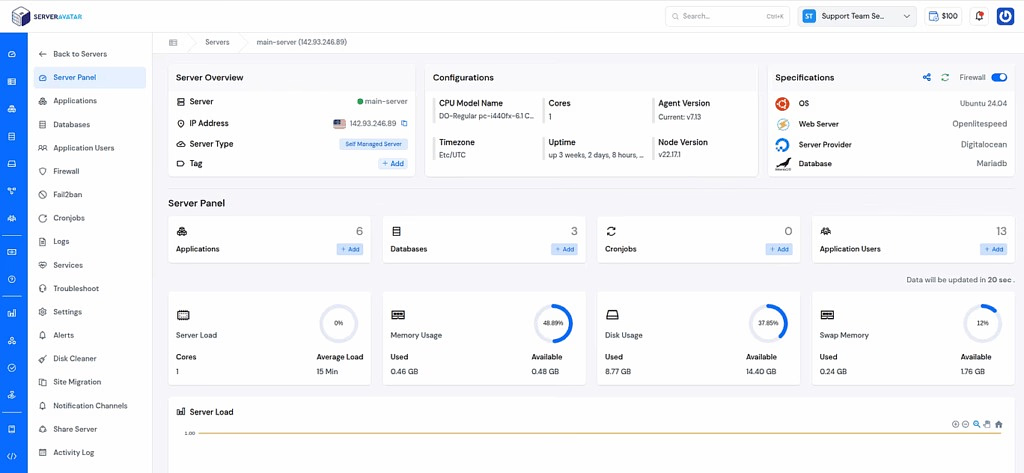
ServerAvatar is a platform to simplify the hosting and management of servers and applications. It simplifies the process of deploying and managing PHP and Node.js based web applications on servers.
Instead of spending time manually configuring your server, you can focus on building and scaling your application.
Key Benefits of Using ServerAvatar
- Optimized for MySQL Environments: ServerAvatar is built to work seamlessly with MySQL, ensuring stable performance for web applications.
- One-Click Application Deployment: Quickly deploy PHP applications that rely on MySQL without manual configuration.
- Automated Backups: Easily create instant backups and schedule backups to protect your applications and MySQL databases and prevent data loss.
- Real-Time Server Monitoring: Keep track of your server and database performance to identify issues early.
- Simple and Clean Dashboard: Manage your databases, applications, and servers from an easy-to-use interface.
- Managed Server Option: Use fully managed servers where everything, including MySQL setup, is handled for you.
Why This Matters
If your project leans toward MySQL, which is often the case for web applications like WordPress or eCommerce platforms, using ServerAvatar can significantly reduce your workload. It helps you:
- Save time on setup and maintenance
- Avoid configuration mistakes
- Scale your application without stress
In short, if you choose MySQL for its simplicity and speed, ServerAvatar enhances that experience by making server and database management smooth, efficient, and hassle-free.
Conclusion
Choosing between PostgreSQL and MySQL ultimately comes down to your project’s needs and future goals. If your application requires advanced features, complex queries, and high data integrity, PostgreSQL is a strong choice. On the other hand, if you prioritize simplicity, speed, and ease of setup, MySQL is often the better fit for web-based applications. Both databases are reliable and widely used, so you’re not making a wrong decision either way. The key is to match the database to your workload, and if you choose MySQL, using a platform like ServerAvatar can further simplify deployment, management, and scaling.
FAQs
1. Is MySQL faster than PostgreSQL?
MySQL is generally faster for simple, read-heavy operations, whereas PostgreSQL performs better when handling complex queries and large datasets.
2. Which database is easier for beginners?
MySQL is considered more beginner-friendly because of its simple setup and ease of use, making it a popular choice for new developers.
3. Can I switch from MySQL to PostgreSQL later?
Yes, it is possible to migrate between databases, but it may require effort in terms of data conversion, query adjustments, and application changes.
4. Which database is more secure?
Both databases offer strong security features, but PostgreSQL provides more advanced options like row-level security and fine-grained access control.
5. Why should I use ServerAvatar with MySQL?
ServerAvatar simplifies server and database management by offering features like one-click deployment, automated backups, monitoring, and an easy-to-use dashboard, helping you save time and reduce manual work.
6. Which database should I choose for a WordPress website?
MySQL is the best choice for WordPress since it is fully compatible and widely supported across hosting platforms.