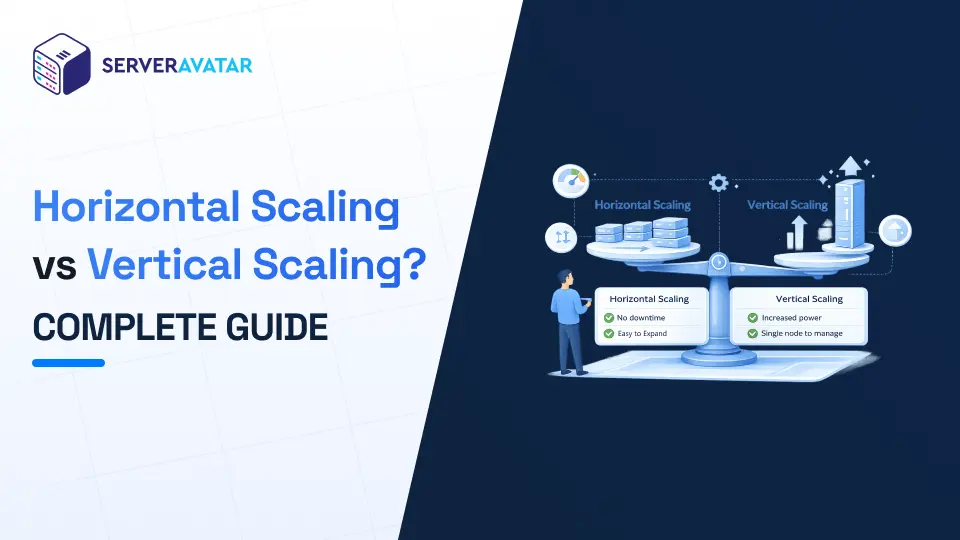

As applications and websites grow, they must handle increasing numbers of users, requests, and data without slowing down or failing. This is where scaling becomes essential. Scaling is the process of adjusting system resources so performance remains stable as demand increases. In this guide, I will explain horizontal scaling vs vertical scaling, how each approach works, and when to use them for reliable and scalable systems.
What Is Scaling?
Scaling is the process of increasing or adjusting system resources so an application can handle higher workloads without performance issues. It ensures the system continues to function efficiently as demand increases over time.
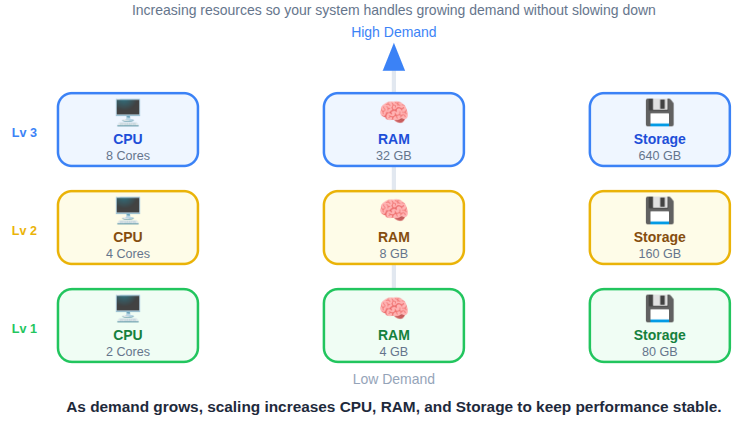
The primary goal of scaling is to maintain performance, reliability, and availability as demand grows.
Why Scaling Is Important?
Without proper scaling, systems may struggle under increased demand, leading to slow performance or service failures. Scaling helps applications remain stable and responsive as usage grows.
Proper scaling helps ensure:
- Consistent performance: Ensures stable response times under load
- Improved system stability: Reduces the risk of crashes or failures
- Better user experience: Maintains smooth and reliable interactions
- Efficient use of resources: Prevents overuse or underutilization
Scaling is not optional for growing systems; it is a fundamental requirement.
Understanding Vertical Scaling
Vertical scaling focuses on increasing the capacity of a single server or system. This is achieved by upgrading existing resources rather than changing the system structure.
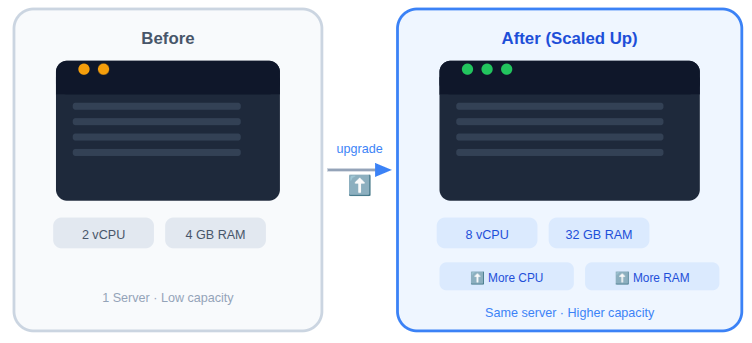
Vertical scaling concentrates on improving the power of one unit instead of distributing tasks across multiple units.
Key Features of Vertical scaling:
Vertical scaling focuses on strengthening a single system by improving its internal resources without changing the overall structure.
- Single-system enhancement: Resources are upgraded within one system
- Centralized workload handling: All processing occurs in one place
- Minimal architectural change: No redesign of system structure
Pros of Vertical scaling:
Vertical scaling offers a straightforward way to improve system performance with minimal complexity.
- Simple implementation: Does not require changes to system architecture
- Easier management: Monitoring is limited to one system
- Quick performance improvements: Resource upgrades provide immediate benefits
- Lower complexity: Suitable for early-stage or smaller systems
Cons of Vertical scaling:
Despite its simplicity, vertical scaling has inherent limitations that affect long-term growth.
- Hardware limits: Resource upgrades have a fixed maximum
- Single point of failure: One system supports all operations
- Possible downtime: Upgrades may require system restarts
- Rising costs: High-capacity systems become expensive
These limitations make vertical scaling less suitable for long-term growth.
How Vertical Scaling Works
Vertical scaling works by increasing available system resources while keeping the application on the same system.
- Processing power: Improves computation speed
- Memory capacity: Allows handling of more data simultaneously
- Storage limits: Supports larger data volumes
The application continues to run on the same system, but with higher resource availability. This approach does not require changes to application architecture.
When Vertical Scaling Is Suitable
Vertical scaling works best in controlled and predictable environments.
- Small to medium systems: Resource needs are manageable
- Predictable workloads: Demand does not fluctuate heavily
- Simplicity is required: Minimal operational complexity
- No architectural changes desired: Existing structure is retained
It is often used as an initial scaling approach.
Understanding Horizontal Scaling
Horizontal scaling involves increasing capacity by adding multiple systems that work together. Instead of increasing power within one system, workloads are distributed across several systems.
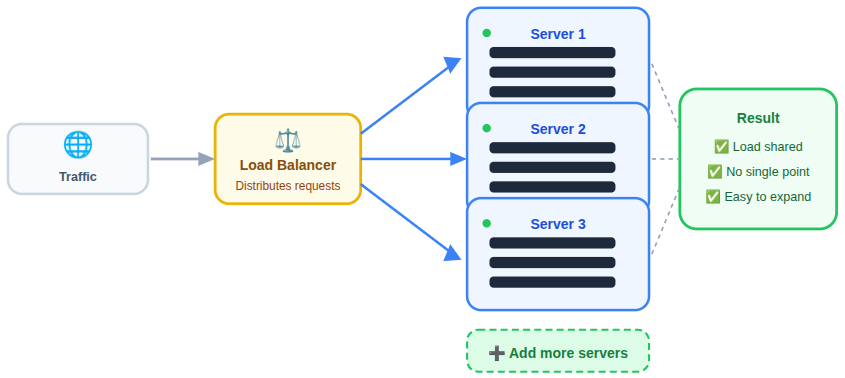
This method emphasizes distribution rather than concentration of resources.
Key Features of Horizontal Scaling:
Horizontal scaling increases system capacity by distributing workloads across multiple systems.
- Multiple systems working together: Several systems operate in parallel.
- Distributed workload handling: Tasks are shared to balance resource usage.
- Scalable expansion: Capacity grows by adding more systems as needed.
Pros of Horizontal Scaling:
Horizontal scaling is designed for environments with high or unpredictable demand.
- High availability: System remains operational during partial failures
- Better fault tolerance: Individual system issues have limited impact
- Scalable growth: Capacity can be expanded gradually
- Improved performance under load: Workload distribution reduces strain
These features make horizontal scaling suitable for high-demand environments.
Cons of Horizontal Scaling:
While powerful, horizontal scaling introduces additional complexity.
- Higher complexity: Requires careful system planning
- Data synchronization needs: Consistency must be maintained across systems
- Increased management effort: More components require monitoring
- Initial setup requirements: Proper configuration is essential
It is powerful but requires a well-structured approach.
How Horizontal Scaling Works
Horizontal scaling relies on distributing workloads across multiple systems.
- Multiple systems run the same application: Ensures consistent functionality
- Incoming requests are distributed: Load is balanced across systems
- Each system handles part of the workload: Improves overall capacity
This structure allows incremental growth and flexibility.
When Horizontal Scaling Is Suitable
Horizontal scaling is ideal for systems that must handle changing demand.
- Variable or growing demand: Capacity can adjust dynamically
- High availability requirements: System uptime is critical
- Minimal downtime tolerance: Failures must not disrupt service
- Long-term scalability needs: Growth is expected over time
This approach supports sustained growth and reliability.
Horizontal vs Vertical Scaling
The primary difference between the two approaches is how capacity is increased.
- Vertical scaling: Increases the capacity of a single system
- Horizontal scaling: Increases the number of systems
| Aspect | Horizontal Scaling | Vertical Scaling |
| Concept | Expanding system capacity by adding more servers or nodes | Expanding system capacity by adding resources (CPU, RAM, storage) to an existing server |
| Performance Improvement | Improves performance by distributing workload across multiple servers | Improves performance by boosting individual server capability |
| Scalability | Highly scalable, can add servers as needed, almost unlimited | Limited by hardware capacity, upgrades eventually hit a ceiling |
| Cost | Can be cost-effective with commodity hardware, but increases management complexity | May be expensive due to high-end hardware requirements |
| Reliability | High, failure of one server usually doesn’t affect the system | Low, if the server fails, the system may go down |
| Complexity | Higher, requires load balancing, replication, and distributed management | Ideal for variable traffic, web apps, cloud applications, and distributed databases |
| Downtime | Usually minimal downtime when adding new servers | May require downtime during hardware upgrades |
| Use Case | Upgrading the database server RAM/CPU, enhancing a high-performance server | Ideal for applications needing strong single-server performance, legacy apps, CPU/RAM-intensive apps |
| Examples | Adding nodes to a web server cluster, scaling cloud services | Upgrading database server RAM/CPU, enhancing a high-performance server |
Vertical scaling prioritizes simplicity, while horizontal scaling prioritizes resilience and scalability.
When to Choose Vertical Scaling
Vertical scaling is suitable for improving performance quickly with minimal effort.
- Small or medium applications: Limited resource demands
- Need for quick improvements: Immediate performance gains
- Preference for simplicity: Reduced operational overhead
- Limited budget and time: Lower initial investment
It’s often the first step before moving to something more advanced.
When to Choose Horizontal Scaling
Horizontal scaling is designed for systems that must remain available under all conditions.
- Unpredictable or rapid traffic growth: Flexible capacity expansion
- Zero or minimal downtime tolerance: High reliability required
- Need for high availability: Continuous system operation
- Long-term growth plans: Sustainable scalability
If your system must stay online no matter what, horizontal scaling is usually the answer.
How ServerAvatar Supports Horizontal and Vertical Scaling
Implementing scaling becomes easier when infrastructure management is simplified. ServerAvatar provides managed servers that support both vertical and horizontal scaling, allowing users to adjust resources based on workload requirements.
What is ServerAvatar?
ServerAvatar is a platform to simplify the hosting and management of servers and applications. It simplifies the process of deploying and managing PHP and Node.js based web applications on servers.
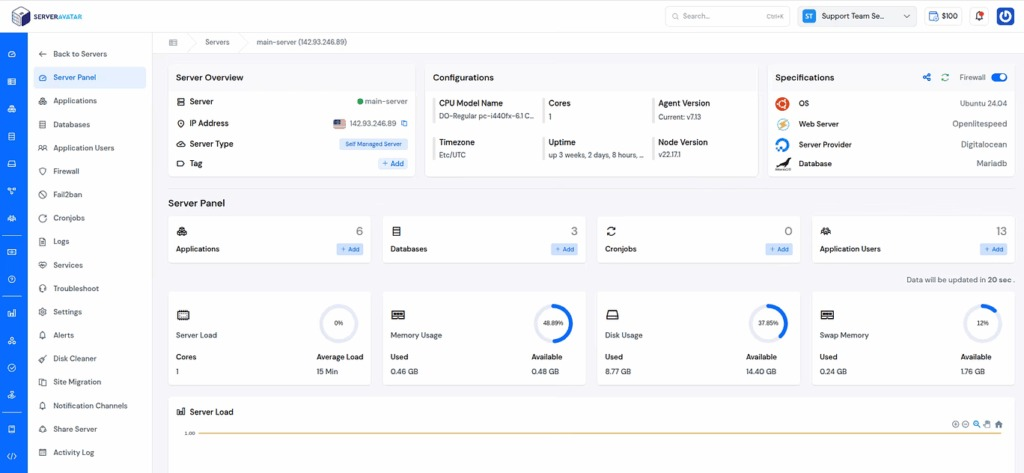
For vertical scaling, ServerAvatar offers a built-in server resize option that enables users to increase or decrease server resources as needed. This helps improve performance without requiring manual server reconfiguration or application-level changes. The resize process is designed to be controlled and predictable, making it suitable for systems with evolving resource demands.
For horizontal scaling, ServerAvatar enables users to deploy and manage multiple servers from a centralized dashboard, making it easier to distribute workloads across instances. When combined with proper load balancing and application configuration, this supports horizontal scaling by allowing traffic to be distributed across multiple servers for improved availability and scalability.
Server Resizing and Scaling Flexibility in ServerAvatar
ServerAvatar’s managed server resize feature allows vertical scaling to be performed when resource requirements change. This capability helps ensure that applications continue to operate efficiently as demand increases or decreases. By combining resizing with multi-server management, ServerAvatar supports scalable infrastructure planning aligned with both short-term adjustments and long-term growth goals.
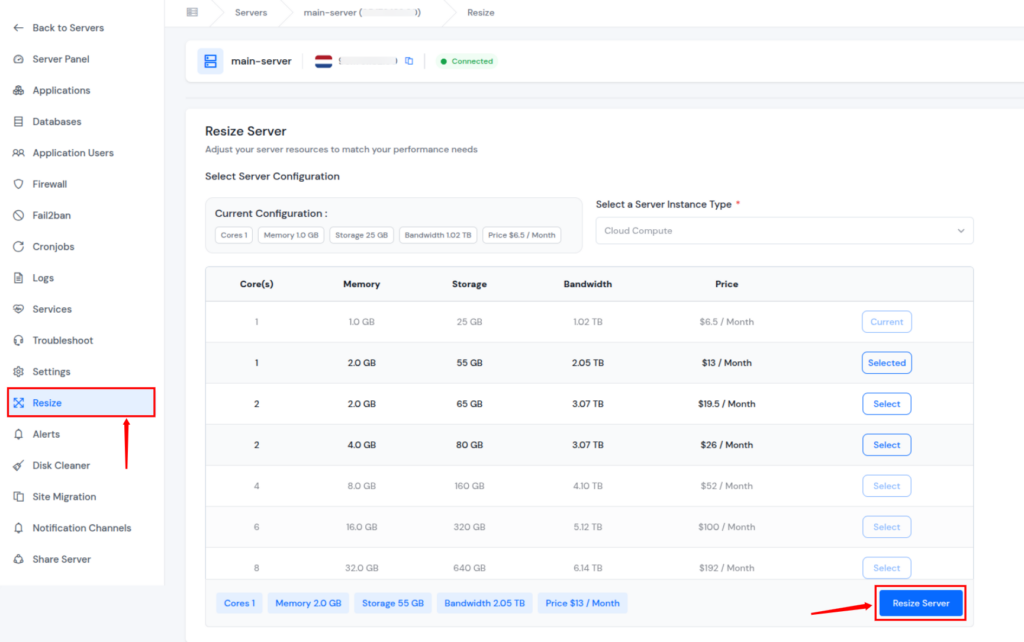
ServerAvatar makes it easier to apply horizontal and vertical scaling strategies by offering managed servers with flexible resizing and multi-server management options.
Common Myths About Scaling
Let’s clear up a few misunderstandings:
- Myth: Horizontal scaling is always better
Truth: It depends on your needs - Myth: Vertical scaling is outdated
Truth: It’s still useful and widely used - Myth: Scaling is only for big companies
Truth: Even small projects need scaling plans
Scaling isn’t about size; it’s about preparedness.

Key Considerations Before Choosing a Scaling Method
Selecting the right scaling approach requires evaluating both current and future needs.
- Expected growth patterns: Anticipated increase in demand
- Budget constraints: Cost of upgrades and maintenance
- Performance requirements: Required response times and stability
- System architecture: Compatibility with scaling methods
- Maintenance capabilities: Ability to manage complexity
Choosing the right scaling strategy depends on both current needs and future goals.
Conclusion
Understanding the difference between horizontal and vertical scaling is essential for building systems that can grow without performance or stability issues. Vertical scaling offers a simple way to improve capacity by enhancing a single server, while horizontal scaling focuses on distributing workloads across multiple servers for better resilience and long-term scalability. The right approach depends on workload patterns, availability requirements, and future growth plans. ServerAvatar make it easier to apply both scaling strategies by offering managed servers with flexible resizing and centralized multi-server management, helping teams adapt infrastructure efficiently as demands change.
FAQs
1. What is the main difference between horizontal and vertical scaling?
Vertical scaling increases the resources of a single server, while horizontal scaling increases capacity by adding more servers to share the workload.
2. Is vertical scaling suitable for long-term growth?
Vertical scaling is effective for short- to medium-term needs, but it has hardware limits that can make it less suitable for long-term growth.
3. Why is horizontal scaling considered more reliable?
Horizontal scaling improves reliability by distributing workloads, so system operations can continue even if one server experiences issues.
4. How do managed servers simplify scaling decisions?
Managed servers reduce the technical effort involved in scaling by handling server maintenance, resource adjustments, and infrastructure management, allowing teams to focus on application performance rather than server complexity.
5. How does managed server infrastructure help with scaling?
Managed server provided by the ServerAvatar platform simplifies scaling by handling server configuration and resource management, allowing scaling changes to be applied with minimal operational effort.