

Have you ever wondered why so many modern websites and apps feel incredibly fast and responsive? Whether you’re streaming videos, chatting in real time, or shopping online, there’s a good chance Node.js is working behind the scenes. This is exactly why Node.js for web development has become such a popular topic, as businesses and developers look for faster, more scalable ways to build modern applications.
In 2026, web development has evolved dramatically. Users expect lightning-fast performance, seamless experiences, and real-time interactions. That’s exactly where Node.js shines. So, why is Node.js considered the best choice for web development today? Let’s understand it simply.
What is Node.js?
Node.js is an open-source runtime environment that allows developers to run JavaScript on the server side. In simple terms, it lets you use the same language (JavaScript) for both front-end and back-end development.
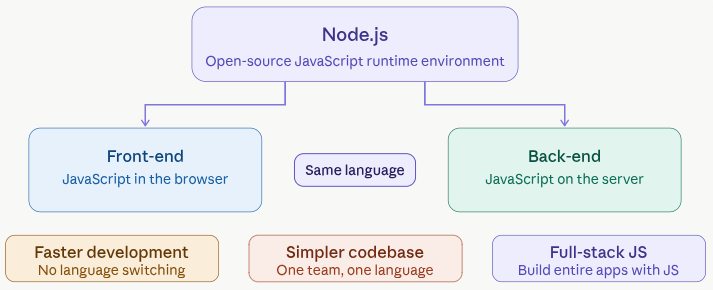
Instead of switching between different programming languages, developers can build entire applications using just one. That’s a huge advantage in terms of speed and simplicity.
Why Node.js is Popular in 2026
Node.js has grown from a niche tool to a mainstream technology. Today, it powers some of the biggest platforms and applications in the world.
Key reasons for its popularity:
- Fast execution speed
- Real-time capabilities
- Easy scalability
- Developer-friendly ecosystem
With businesses demanding faster and more interactive web apps, Node.js fits perfectly into modern development needs.
Why Node.js Stands Out for Web Development in 2026
Choosing the right technology can feel overwhelming, especially with so many options available today. But if you’re looking for something fast, flexible, and future-ready, Node.js naturally comes to the top of the list.
In 2026, web applications are no longer just about displaying content, they’re about delivering real-time, interactive experiences. Node.js is built exactly for that. Its non-blocking architecture allows apps to handle multiple users at once without slowing down, making it ideal for modern platforms.
Another big advantage is developer efficiency. Since Node.js uses JavaScript on both the front-end and back-end, teams can work faster without constantly switching between languages. This not only saves time but also reduces errors and improves collaboration.
On top of that, Node.js continues to evolve with new tools, frameworks, and updates. So when you choose Node.js, you’re not just picking a technology for today, you’re investing in something that will stay relevant for years to come.
Reasons Node.js Is the Best Choice for Web Development in 2026
With evolving user expectations and modern development needs, choosing the right technology is more important than ever. Here are the key reasons why Node.js continues to stand out.
Reason 1: High Performance and Speed
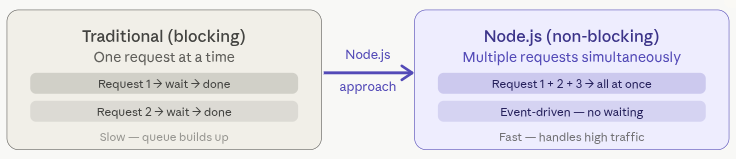
One of the biggest reasons developers love Node.js is its incredible speed. Node.js uses a non-blocking, event-driven architecture, which means it can handle multiple requests at the same time without waiting for one to finish before starting another.
Why this matters
- Faster loading websites
- Better user experience
- Reduced server load
Key Advantages
- Handles multiple requests at the same time without delays
- Faster page load times improve user experience
- Efficient use of server resources reduces overhead
- Ideal for data-heavy and high-traffic applications
- Built on a fast JavaScript engine for quick execution
Imagine a waiter taking multiple orders at once instead of serving one table at a time, that’s exactly how Node.js works.
Reason 2: Real-Time Capabilities
In today’s world, users expect instant updates. Whether it’s messaging apps, live notifications, or online gaming, real-time functionality is essential. Node.js makes real-time communication simple and efficient.
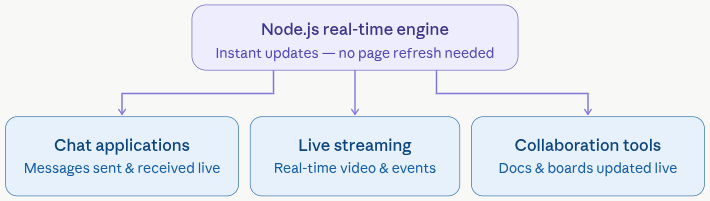
Examples of real-time features
- Chat applications
- Live streaming
- Online collaboration tools
Key Advantages
- Enables instant data updates without refreshing the page
- Perfect for chat apps, live tracking, and notifications
- Supports smooth real-time communication between users
- Reduces latency for better responsiveness
- Enhances user engagement with dynamic content
If your app needs to update instantly without refreshing the page, Node.js is a perfect fit.
Reason 3: Scalability for Growing Apps
As your application grows, handling more users becomes challenging. This is where Node.js truly stands out. It is designed to scale easily, both horizontally and vertically.

Why This Matters
- Your application can handle more users as it grows
- Prevents performance issues during traffic spikes
- Supports business expansion without rebuilding systems
Key Advantages
- Easily scales horizontally by adding more servers
- Works well with microservices architecture
- Handles large volumes of concurrent connections
- Flexible enough for both small and large projects
- Supports cloud-based scaling environments
Whether you’re building a small app or a global platform, Node.js grows with you.
Reason 4: JavaScript Everywhere
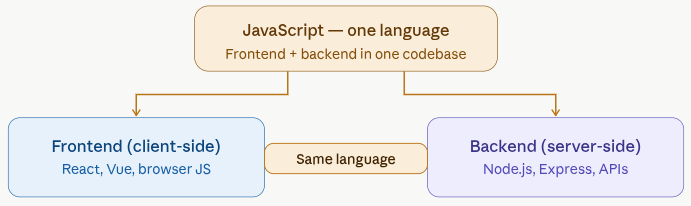
Using Node.js means you can write both frontend and backend code in JavaScript. This simplifies development and helps teams work faster and more efficiently.
Why is this important?
- No need to learn multiple languages
- Faster development process
- Easier team collaboration
Key Advantages
- Use single language for frontend and backend both
- Reduces development time and complexity
- Makes collaboration easier across teams
- Simplifies code maintenance and debugging
- Ideal for full-stack development
Developers can write code for both client-side and server-side using the same language, making the entire workflow more efficient.
Reason 5: Massive Ecosystem (NPM)
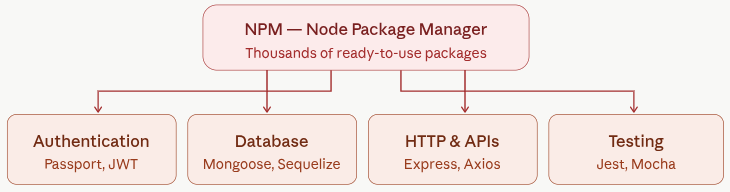
Node.js offers access to a huge collection of ready-made packages through NPM. This helps developers build applications quickly without starting everything from scratch.
What does this mean for you?
- Ready-made solutions for common problems
- Faster development time
- Access to thousands of tools
Key Advantages
- Access to thousands of ready-to-use packages
- Speeds up development by avoiding repetitive coding
- Wide range of tools for almost any functionality
- Regularly updated libraries for modern needs
- Helps developers focus more on core features
Instead of building everything from scratch, developers can simply use existing packages and save time.
Reason 6: Strong Community Support
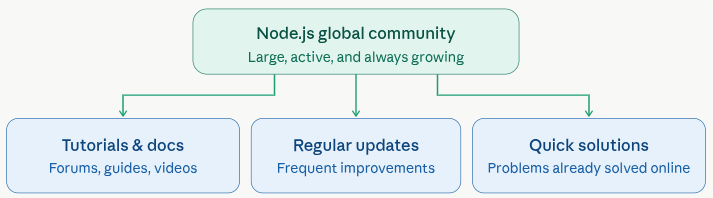
A large and active community supports Node.js, making it easy to find help and resources. Regular updates and shared knowledge keep the ecosystem strong and reliable.
Why this matters:
- Quick solutions to problems
- Regular updates and improvements
- Tons of tutorials and resources
Key Advantages
- Large global community for help and guidance
- Plenty of tutorials, forums, and documentation
- Frequent updates and improvements
- Easy to find solutions to common problems
- Continuous innovation driven by developers
If you ever get stuck, chances are someone has already solved that problem and shared the solution online.
Reason 7: Cost-Effective Development
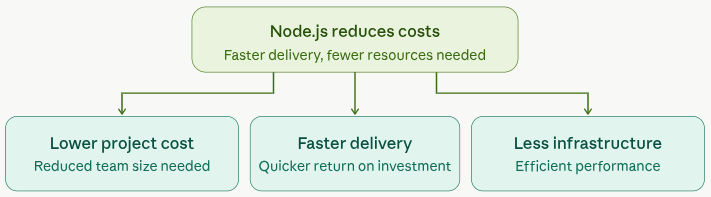
Node.js reduces development costs by speeding up the process and requiring fewer resources. It’s an efficient choice for businesses looking to build powerful applications within budget.
Why This Matters
- Reduces overall project cost and development time
- Minimizes the need for large development teams
- Faster delivery means quicker return on investment
Key Advantages
- Single-language development lowers hiring costs
- Faster development cycles save time and money
- Reusable code reduces effort and duplication
- Efficient performance lowers infrastructure costs
- Ideal for startups and budget-conscious projects
Since developers can use JavaScript across the entire stack, companies save both time and resources.
Node.js Compared to Other Technologies
Before choosing any backend technology, it’s important to see how it compares with other popular options. This helps you understand where Node.js stands and whether it truly fits your project needs.
Node.js vs Traditional Servers:
- Node.js: Non-blocking, fast
- Traditional: Blocking, slower
Node.js vs PHP/Python:
- Node.js excels in real-time apps
- Others are better for specific use cases
Here’s a simple comparison to help you see the differences clearly:
| Feature | Node.js | PHP | Python (Django/Flask) | Java (Spring Boot) |
| Performance | Very fast (non-blocking) | Moderate | Moderate | High but resource-heavy |
| Scalability | Excellent | Limited | Good | Excellent |
| Real-Time Support | Built-in strength | Weak | Limited | Moderate |
| Learning Curve | Easy (JavaScript-based) | Easy | Easy to moderate | Complex |
| Use Case | Real-time apps, APIs | CMS, websites | Data-driven apps | Enterprise systems |
What does this mean for you?
- If you need real-time features, Node.js is a clear winner
- If you want fast development with a single language, Node.js makes life easier
- If you’re building modern, scalable apps, Node.js is often the better choice
That said, other technologies still have their place. But for speed, flexibility, and modern web needs, Node.js offers a strong edge.
Use Cases of Node.js in 2026
Node.js is used across a wide range of modern applications, from startups to large-scale platforms. Let’s explore where it performs best and why developers prefer it for these use cases.
Popular use cases include:
- E-commerce platforms
- Streaming services
- Social media apps
- APIs and microservices
If your application needs speed and scalability, Node.js is a strong contender.
Is Node.js Right for You?
Not every technology is the perfect fit for every project. Asking the right questions can help you decide if Node.js aligns with your goals and development requirements.
- Do you need real-time features?
- Is performance a top priority?
- Do you want faster development?
If the answer is yes, Node.js is likely a great choice for your project.
Common Challenges and Solutions
Like any technology, Node.js comes with its own set of challenges. The good news is that most of these can be managed easily with the right approach and best practices.
Common issues:
- Not ideal for CPU-heavy tasks
- Callback complexity
- Managing large applications
Solutions:
- Use worker threads for heavy tasks
- Adopt modern async/await syntax
- Structure your app using best practices
With the right approach, these challenges can be easily managed.
Simplify Node.js Deployment and Management with ServerAvatar
Building a Node.js application is one part of the journey, but deploying and managing it efficiently is where many developers face challenges. From server setup and configuration to handling updates and performance monitoring, the process can quickly become complex. This is where ServerAvatar makes things easier.
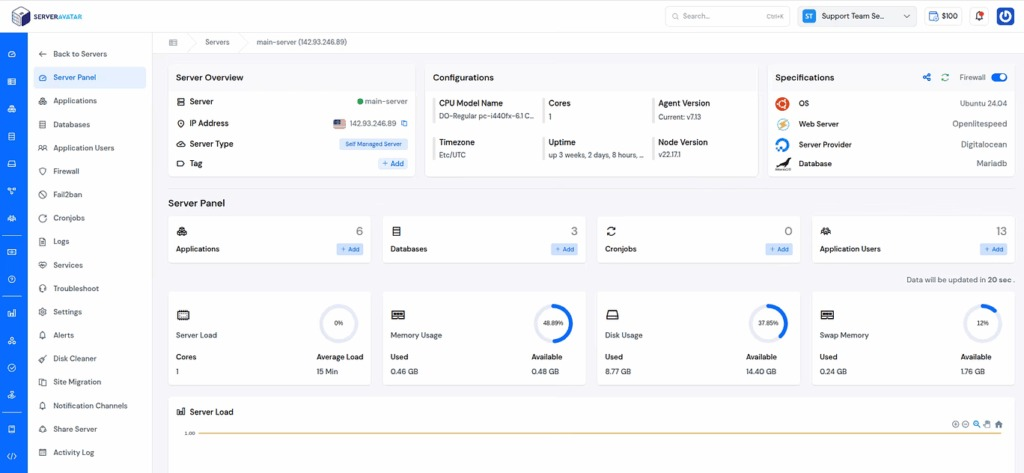
ServerAvatar is a platform to simplify the hosting and management of servers and applications. It provides a simple and powerful platform to deploy and manage Node.js applications without dealing with complicated server-level tasks.
With ServerAvatar, you can:
- Deploy PHP and Node.js applications in just a few clicks
- Manage servers and applications without deep DevOps knowledge
- Monitor performance and logs from a single dashboard
- Manage security features directly from the dashboard
Instead of spending time on manual configurations, developers can focus more on building features and improving their applications. Whether you’re working on a small project or a production-level system, ServerAvatar helps streamline the entire deployment process.
If you’re looking for a faster and more efficient way to manage Node.js applications, using ServerAvatar can significantly simplify your workflow.
Node.js for Large-Scale Applications and Future-Ready Systems
Node.js has evolved far beyond its early reputation as a tool mainly used by startups. Today, it plays a key role in powering large-scale, high-demand applications used by businesses around the world.
This evolution highlights how stable, reliable, and production-ready the Node.js ecosystem has become over time.
Why Enterprises Trust Node.js Today
Modern applications require more than just speed. They need to be secure, scalable, and consistently reliable under heavy workloads. Node.js checks all these boxes, making it a strong choice for enterprise-level development.
Key reasons enterprises choose Node.js:
- Long-Term Support (LTS): Regular updates ensure stability, security, and long-term reliability
- Strong governance: Backed by the OpenJS Foundation for structured and consistent development
- High scalability: Handles increasing users and sudden traffic spikes with ease
Because of these strengths, Node.js is widely trusted for applications where performance and uptime are critical.
Future-Ready Architecture with Node.js
As technology continues to evolve, applications must be flexible enough to adapt to new trends and infrastructure. Node.js is designed to support modern architectures that prioritize speed, efficiency, and scalability.
Here’s how Node.js supports next-generation systems:
- Lightweight runtime: Ideal for edge computing, allowing faster data processing closer to users
- Serverless compatibility: Integrates smoothly with modern cloud and serverless platforms
- Quick startup time: Reduces delays, especially in dynamic environments
- Simplified development: Using JavaScript across services makes systems easier to build and maintain
In short, Node.js helps developers create applications that are not only efficient today but also ready for future demands.
Conclusion
In today’s fast-paced digital world, building web applications that are quick, scalable, and responsive is no longer optional, it’s essential. Node.js stands out as a powerful solution that meets these expectations by enabling real-time functionality, efficient performance, and streamlined development using a single language. From startups to large enterprises, its flexibility and growing ecosystem make it a reliable choice for modern web development. When combined with the right deployment and management approach, Node.js not only simplifies development but also helps you build applications that are ready to scale and adapt in the future.
Frequently Asked Questions
1. What makes Node.js different from other backend technologies?
Node.js uses a non-blocking, event-driven architecture, which allows it to handle multiple requests simultaneously. This makes it faster and more efficient for real-time and high-traffic applications compared to traditional backend technologies.
2. Is Node.js suitable for large-scale applications?
Node.js is widely used for large-scale and enterprise-level applications. Its scalability and performance make it ideal for handling high user loads and complex systems.
3. What are the common use cases of Node.js?
Node.js is commonly used for real-time applications like chat apps, streaming platforms, APIs, eCommerce websites, and microservices-based architectures.
4. Is Node.js good for beginners?
Node.js is beginner-friendly, especially for developers who already know JavaScript. Its large community and extensive documentation make it easier to learn and use.
5. What are the limitations of Node.js?
Node.js may not be the best choice for CPU-intensive tasks, as it is optimized for handling asynchronous operations. However, these limitations can be managed using techniques like worker threads.
6. How can I deploy a Node.js application easily?
Deploying a Node.js application can be simplified using platforms like ServerAvatar, which allow you to manage servers, deploy applications, and monitor performance without complex configurations.