
If you’re starting a PHP project today, one question comes up almost immediately: should you use Core PHP or go with a modern framework like Laravel? The Core PHP vs Laravel decision isn’t a simple either; it depends entirely on the scale, complexity, and long-term plans for what you’re building. At first glance, both options can get the job done. But the difference becomes clear as your project grows. What feels simple in the beginning can quickly turn complex, harder to manage, and time-consuming.
In recent years, modern PHP development has increasingly shifted toward frameworks like Laravel due to their efficiency and built-in features. The truth is, choosing between Core PHP and Laravel is not about which one is “better”. It’s about choosing what fits your project today and what will still work for you tomorrow.
In this guide, you’ll get a clear, practical comparison grounded in real development scenarios, not just feature lists, so you can make the right call without guesswork.
What Is Core PHP?
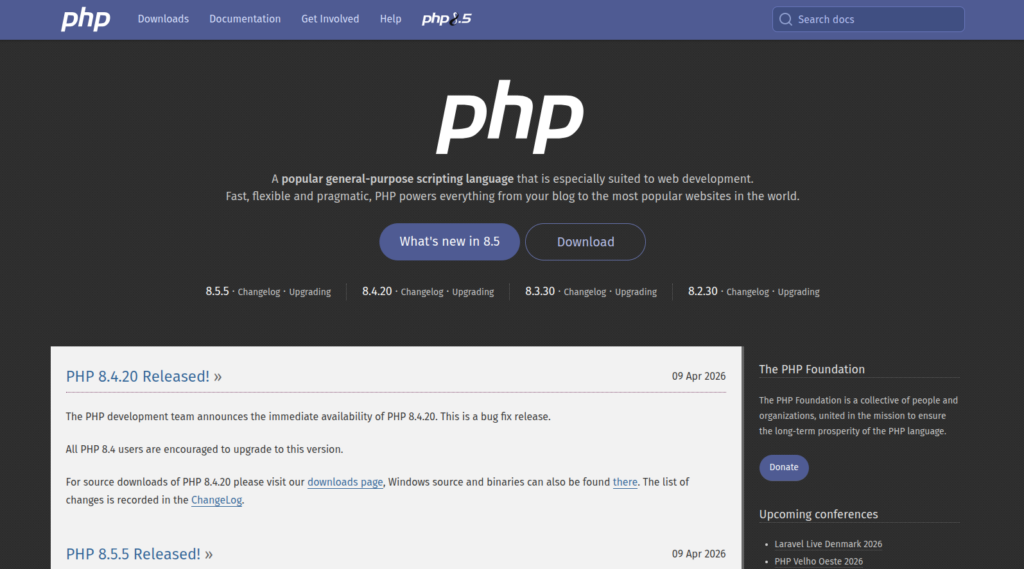
Core PHP refers to using plain PHP without any frameworks. You write everything from scratch, including routing, database queries, authentication, and business logic. This gives you full control over how your application works. But it also means you’re responsible for everything.
Key Characteristics of Core PHP:
- No framework overhead, lightweight and fast execution out of the box
- Full control over code structure and logic, with no conventions imposed on you
- Compatible with nearly all hosting environments, including minimal shared hosting
- Easy to get started if you already know basic PHP
- Completely flexible for building custom solutions from the ground up
Advantages of Core PHP:
- High performance due to minimal abstraction between your code and the server
- Complete control over every aspect of how the application behaves
- No dependency on framework release cycles or updating conventions
- Ideal for small, focused applications where you know exactly what you’re building
- Lower barrier to entry for developers with basic PHP knowledge
Disadvantages of Core PHP:
- No built-in security layer, SQL injection, XSS, and CSRF must be handled manually
- Repetitive coding patterns by default, reusable components have to be built from scratch
- Maintenance becomes significantly harder as the codebase grows
- No standardized project structure, which makes team collaboration tricky
- Development velocity drops noticeably on anything beyond small-scale projects
Best For: Small projects, simple websites, and developers who need full control without framework conventions, or who are working in highly constrained server environments.
What Is Laravel?
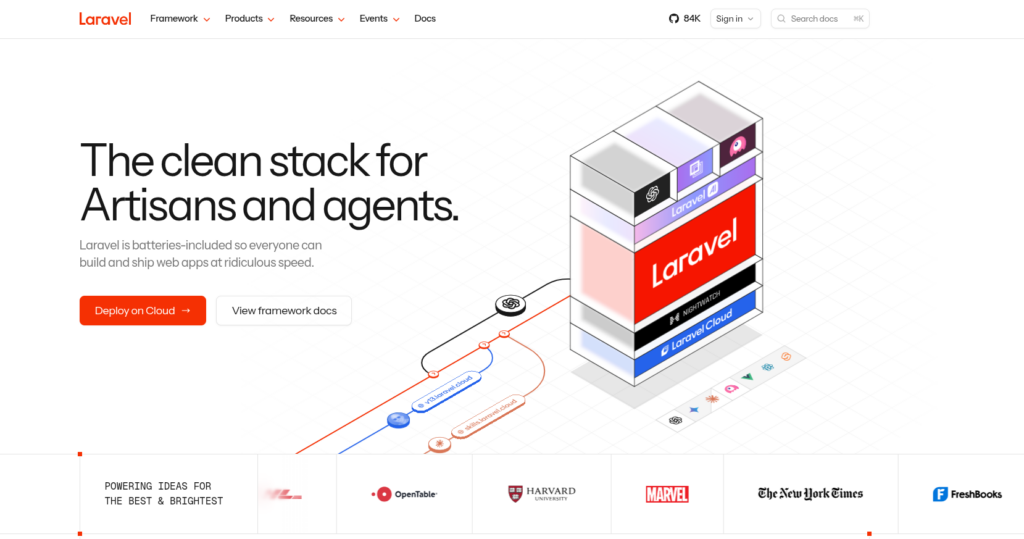
Laravel is a modern PHP framework designed to simplify and speed up development. It comes with built-in tools, a clean architecture, and follows best practices out of the box. Instead of building everything from scratch, Laravel gives you a structured foundation to build on.
Key Features of Laravel:
- MVC (Model-View-Controller) architecture that separates concerns cleanly
- Built-in authentication and authorization systems that are production-ready
- Eloquent ORM for intuitive database management without raw SQL everywhere
- Blade templating engine for reusable, composable views
- Built-in protection against common threats: CSRF, XSS, and SQL injection
- Artisan CLI for automating repetitive development tasks
Advantages of Laravel:
- Clean and structured codebase that new developers can navigate quickly
- Faster development cycles thanks to pre-built, tested components
- Strong security features enabled by default rather than bolted on
- A large ecosystem of official packages and community-driven tools
- Designed for scalability, adding features doesn’t mean rewriting the foundational applications
Disadvantages of Laravel:
- Slightly slower performance than bare Core PHP due to framework layers
- A steeper learning curve for developers unfamiliar with MVC and PHP namespaces
- Higher server resource requirements, especially for memory-intensive applications
- Framework updates occasionally introduce breaking changes that require migration work
- Can be excessive overhead for very small, single-purpose projects
Best For: Medium to large applications, scalable projects, and teams that want modern tooling, structured code, and faster delivery without reinventing common components.
Quick Comparison Table
While comparing Core PHP and Laravel, it helps to see their differences side by side. This quick comparison gives you a clear view to help you decide which one suits your workflow better.
| Feature | Core PHP | Laravel |
| Type | Raw PHP, no framework | Full PHP framework |
| Learning Curve | Easy for beginners | Moderate, requires MVC familiarity |
| Performance | Faster, no overhead | Slightly slower due to framework layers |
| Development Speed | Slower, everything built from scratch | Faster, pre-built components available |
| Code Structure | No fixed structure | Follows MVC architecture |
| Security | Manual implementation required | Built-in CSRF, XSS, SQL injection protection |
| Database Handling | Manual MySQLi/PDO queries | Eloquent ORM with query builder |
| Scalability | Difficult at scale | Designed for growth |
| Maintenance | Harder as codebase expands | Cleaner, more maintainable long-term |
| Built-in Features | Minimal | Rich: auth, routing, caching, queues, and more |
| Community Support | General PHP community | Large, active Laravel-specific ecosystem |
| Best Use Case | Small, simple, single-purpose projects | Medium-to-large, feature-rich applications |
Key Differences Between Core PHP and Laravel
1. Ease of Development
Core PHP:
- You start from absolute zero, no routing, no session handling, no structure
- Every component needs to be wired up manually, even basic ones
Laravel:
- Pre-built components for authentication, routing, validation, and more available immediately
- A new Laravel project can have a working API in hours, not days
In practice: Once a project has more than a few pages or any user authentication, Laravel’s built-in tools save days of work.
2. Performance
Core PHP: No framework overhead, fastest possible execution.
Laravel: Slight overhead, but Laravel’s caching (Redis, file-based) makes real-world performance very competitive.
In practice: The performance gap is real but rarely the deciding factor.
3. Security
Core PHP: You handle every security decision manually.
Laravel: CSRF, XSS, SQL injection protected by default; bcrypt/argon2 password hashing built in.
In practice: Core PHP can be just as secure, but Laravel makes the secure path the default path.
4. Scalability
Core PHP: Custom code, custom caching, custom session management all required to scale.
Laravel: Built-in query optimization, caching, queue workers, and clean architecture handle growth.
In practice: Laravel scales with less engineering effort.
5. Learning Curve
Core PHP: Accessible to anyone with basic PHP knowledge.
Laravel: MVC, Eloquent, Blade, Artisan, expect 1-3 weeks to feel comfortable.
In practice: Core PHP is easier to start. Laravel is easier to maintain long-term.
6. Development Time
Core PHP: Every feature costs more code; repetitive patterns have to be built fresh each time.
Laravel: Reusable components, Composer packages, and Artisan automation cut development time dramatically.
In practice: For anything beyond a five-page site, Laravel is significantly faster.
7. Maintenance
Core PHP: Code written months later or by different developers varies widely, debugging is hard.
Laravel: Conventions make any Laravel codebase navigable by any Laravel developer.
In practice: Core PHP projects often become unmaintainable as they grow. Laravel projects stay navigable.
Use Cases: When to Choose Core PHP vs Laravel
Choosing between Core PHP and Laravel often comes down to the type of project you’re building and how complex your requirements are. Both have genuine strengths, but they belong to different problem spaces.
When Core PHP Makes Sense
Core PHP works well when you need simplicity, speed, and full control over your code. It’s a good fit for projects where adding a full framework would only increase complexity without meaningful benefit.
- Small business websites or static sites with no dynamic user features
- Simple web applications with a limited, fixed set of features
- Custom scripts or lightweight tools that run as single-purpose processes
- Projects with strict performance requirements where every millisecond matters
- Learning environments where understanding PHP fundamentals matters more than productivity
- Applications deployed to highly constrained server environments with no Composer support
Core PHP is the right choice when the project scope is genuinely small and unlikely to grow significantly.
When Laravel Makes Sense
Laravel is designed for modern web applications that require structure, scalability, and faster development. It shines when you’re building something that will evolve over time or needs robust features from the start.
- Large or complex web applications with multiple features and user roles
- SaaS platforms and subscription-based products with recurring billing and user management
- E-commerce platforms with product catalogs, cart systems, and payment processing
- REST APIs and backend services that power mobile apps or third-party integrations
- Projects requiring authentication, role-based access control, and audit logging
- Applications that need long-term maintenance and multi-developer collaboration
Laravel reduces friction by providing production-ready solutions for problems that Core PHP leaves entirely to you.
When Should You Choose Core PHP?
- Small, simple websites: A five-page site with no database and no user accounts? Core PHP is fine
- One-time scripts or tools: Internal tools that won’t be maintained long-term don’t need framework overhead
- Extremely tight performance constraints: High-frequency API endpoints at scale may genuinely benefit from Core PHP’s raw speed
- Complete control requirements: If the project has non-standard architecture that a framework would fight against, go Core PHP
You need strong coding discipline and security awareness to keep a Core PHP project healthy as it grows.
When Should You Choose Laravel?
- SaaS platforms: User management, billing, teams, and subscriptions are all built in
- Web applications with authentication: Login, registration, password reset, email verification, all handled
- APIs and backend services: Laravel’s API scaffolding, resource controllers, and rate limiting are designed for this
- E-commerce platforms: Inventory, orders, payments, and reporting need the structure Laravel provides
- Projects that need to scale: If the application will grow in users, features, or team size, Laravel scales with it
If you care about development velocity, security defaults, and long-term maintainability, Laravel is the more reliable choice for most modern PHP projects.
A Real-World Perspective
Developers often start with Core PHP because it feels lighter and more honest, you’re not depending on someone else’s code. That instinct is valid. Building from scratch is one of the best ways to understand how the web actually works.
But the limitation becomes apparent quickly. Authentication that seemed simple in theory has dozens of edge cases. The custom routing code you wrote in an afternoon starts conflicting with new features. Database queries that worked at 100 users start struggling at 1,000.
Laravel doesn’t eliminate these challenges, it gives you battle-tested solutions so you’re not solving solved problems. Instead of writing authentication from scratch, you configure it. Instead of building a queue system, you use Laravel’s.
Most professional PHP developers who build significant applications eventually settle on Laravel not because they couldn’t do it in Core PHP, but because their time is better spent building features than maintaining foundations.
Which One Should You Choose Based on Your Role?
For Beginners: Start with Core PHP to understand how PHP actually works underneath. Then move to Laravel, you’ll understand what the framework is doing for you, which makes you better at both.
For Freelancers: Laravel lets you deliver more to clients in less time. Pre-built auth, payments, and admin panels mean realistic project timelines instead of months of foundation work.
For Startups and Businesses: Laravel helps you launch quickly and scale efficiently. Framework overhead is almost always cheaper than rebuilding Core PHP structure when projects inevitably grow.
For Experienced Developers: Even if you prefer Core PHP’s purity, Laravel improves team productivity and keeps projects organized. Enforced conventions beat individual preference in team environments.
Technical Considerations: PHP Version and Hosting Environment
PHP 8.x brought named arguments, match expressions, union types, and attributes, relevant to both Core PHP and Laravel developers. Laravel 11 requires PHP 8.2+ and is a significant simplification over earlier versions.
Hosting environment matters:
- Core PHP runs on virtually any PHP-enabled server, including minimal shared hosting with no SSH access
- Laravel requires SSH for Composer and Artisan, needs VPS, cloud hosting, or a properly configured shared host
If you’re deploying to an environment you don’t control, Core PHP’s portability is a real advantage.

Disclosure: ServerAvatar is referenced here as a hosting management tool. This is not a sponsored section, and ServerAvatar helps streamline running Core PHP or Laravel projects.
Conclusion
Choosing between Core PHP and Laravel comes down to how you plan to build and grow your project. Core PHP offers flexibility and control, but requires more manual effort as complexity increases, and complexity almost always increases.
Laravel provides a structured, efficient, and security-conscious foundation. Its conventions, built-in tools, and ecosystem mean you spend time solving real problems instead of rebuilding common components.
If you’re building something small that genuinely won’t grow, a simple site, a one-off tool, Core PHP is valid. But if you’re building anything that matters, anything that will expand, anything with users or a team, Laravel is the more reliable choice.
This guide was last reviewed and updated in May 2026, reflecting PHP 8.x and Laravel 11.
About the Author
This comparison is based on years of building and maintaining both Core PHP applications and Laravel projects of varying scales, from small client sites to production SaaS platforms handling thousands of users. The goal is to give you a practical decision framework, not a feature comparison you could read anywhere else.
FAQs
1. Do I need a framework for every PHP project?
Not necessarily. For small or simple projects, using Core PHP is often enough. Frameworks like Laravel are more beneficial for complex or long-term projects.
2. Can beginners start with Laravel directly?
Yes, but it may take time to understand concepts like MVC and routing. Many beginners prefer starting with Core PHP before moving to Laravel.
3. Is Core PHP outdated?
No, Core PHP is not outdated. It is still widely used, especially for simple applications and custom scripts, but frameworks like Laravel are more popular for larger projects.
4. Which is faster: Core PHP or Laravel?
Core PHP is slightly faster in raw performance since it has no framework overhead. However, Laravel can be optimized to perform efficiently in real-world applications.
5. Is Laravel suitable for large-scale applications?
Yes, Laravel is designed for scalability and is commonly used to build large, complex applications such as SaaS platforms and APIs.